
Surface-contact sensing
Measurements are taken from the road or pavement surface, avoiding the need to access valves, hydrants or pipe fittings at every survey location.
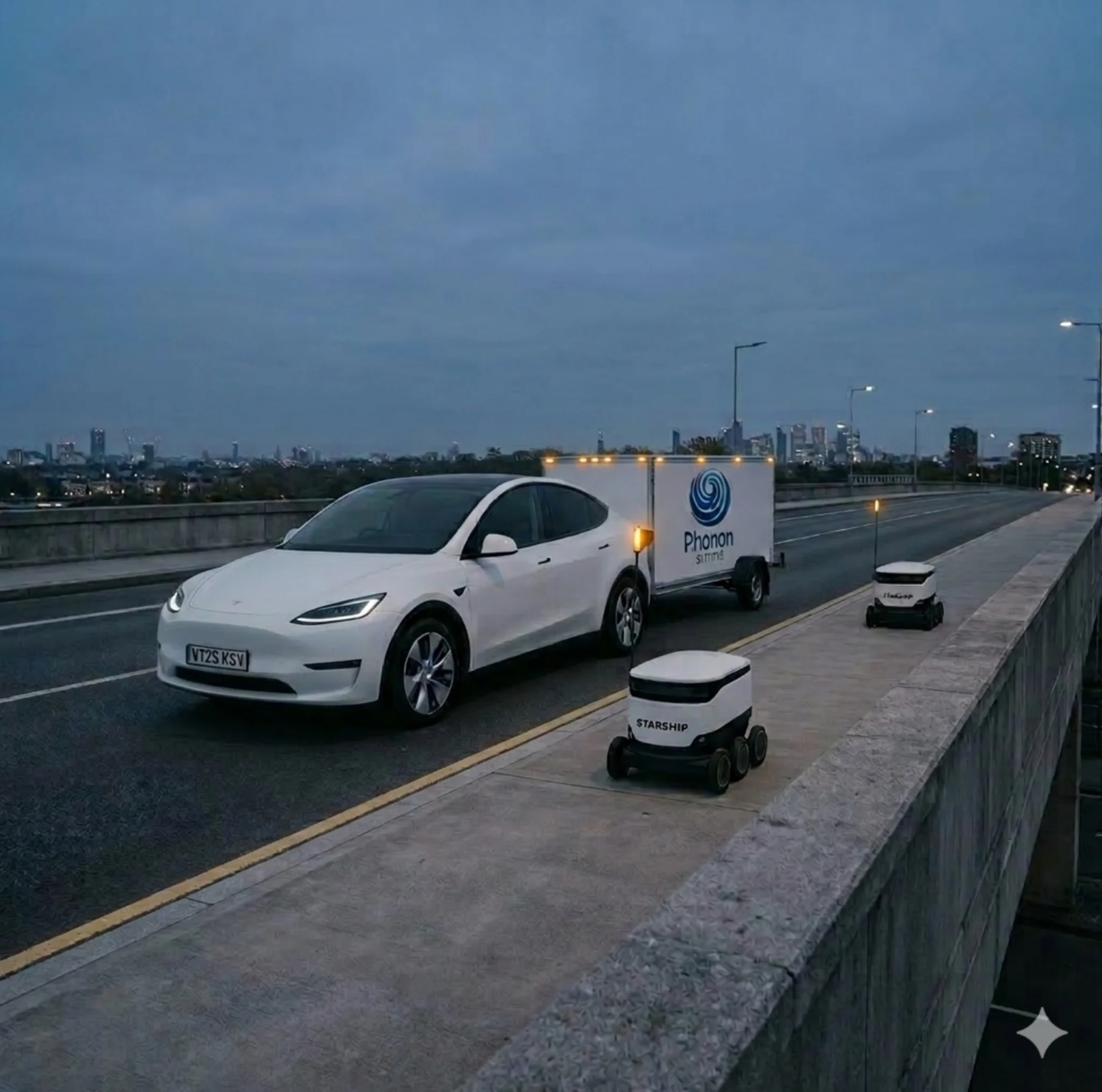
Phonon Systems is developing a mobile acoustic survey system for water networks. The system combines surface-contact sensing, measured sensor geometry and onboard correlation to turn leak noise into a practical location for field teams.
The goal is a repeatable survey workflow: move to a measurement point, place sensors on the surface, record, localise, store the evidence and move on.
Network monitoring can identify likely problem areas, but field teams often still need a second manual sweep with ground microphones and listening sticks before excavation. Phonon is aimed at shortening that route from survey to dig decision.
A reference vehicle or trailer carries a known set of surface-contact acoustic sensors. Separately movable sensor platforms can be positioned on the pavement, verge or footpath. The system measures the live geometry of the array, records synchronised acoustic data and runs the localisation process onboard.
Measurements are taken from the road or pavement surface, avoiding the need to access valves, hydrants or pipe fittings at every survey location.
The system knows where the movable sensors are at the time of each recording, so the array can be flexible rather than manually laid out as a fixed test rig.
Correlation, localisation and decision support can run locally on the vehicle or trailer, with results stored for review or transmitted when connectivity is available.
Phonon has demonstrated the key acoustic measurement chain in prototype form: distributed wireless nodes, synchronised recording, real-time correlation and X/Y source localisation. The next stage is utility-partner field validation on live water-network assets.
Run controlled pilots on known leak areas, hard-to-pinpoint leaks or comparison routes against existing acoustic workflows.
Phonon is not building a self-driving stack. It is a sensing and localisation layer that can be integrated with existing road and pavement mobility platforms.
The approach is capital-efficient: specialist sensing, software and workflow automation built around existing mobility and water-sector infrastructure.
Any named mobility platforms discussed by Phonon are potential integration targets only; no partnership is implied unless separately announced.
Phonon is intended as a specialist sensing and localisation payload for established road and pavement mobility platforms. The examples below are illustrative target platform categories only.

High-volume road vehicles with potential unused overnight survey capacity.
Robotaxi-style autonomy suited to repeatable urban routes and scheduled survey operation.

Purpose-built autonomous mobility platforms for structured urban coverage.

Existing autonomy platforms that could carry or coordinate specialist infrastructure sensors.
Compact pavement robot formats suited to low-speed surface inspection and sensor positioning.
These are examples of integration targets and platform types only. No commercial relationship, endorsement or partnership is implied.
The immediate goal is not a full fleet. It is a focused pilot with the right utility partner: validate field acoustics, prove repeatability, compare against existing workflows and generate evidence that repair teams can use.
Phonon is designed to move leak detection away from expensive fixed infrastructure and toward mobile, surface-based, direct localisation.